
…taken from: London: a Pilgrimage, text by William Blanchard Jerrold, 1872
Following my previous article looking at Gustave Doré’s depictions of the ‘Thames at Work‘, here below are some of his images of the ‘Thames at Play’. And the *play* that made the most impression on him was the famous Oxford v. Cambridge Boat Race. And it was famous. An event enjoyed enthusiastically by Londoners from all backgrounds.
The day he and Jerrold were preparing to watch the race, April 6th, 1870, started out with a thick fog. A classic London smog from the days of domestic coal fires and other sources of pollution. It was “as dark as the darkest midnight… It was choking. It made the eyes ache.”, writes Jerrold.
Doré, having heard of the infamous London smogs, thought that the race would have to be cancelled. “But”, continues Jerrold, “the true Londoners present [where they were lodged], got on with their preparations, inquired about horses and carriages; gave orders; filled cigar cases; and dispatched breakfast.” Doré wondered how such a “tremendous rush along both banks of the river; the blocking of a dozen bridges; the unbroken water procession; and the moving steamers massed to the funnels with humanity”, could all have been brought about by a simple contest between two crews of university students.

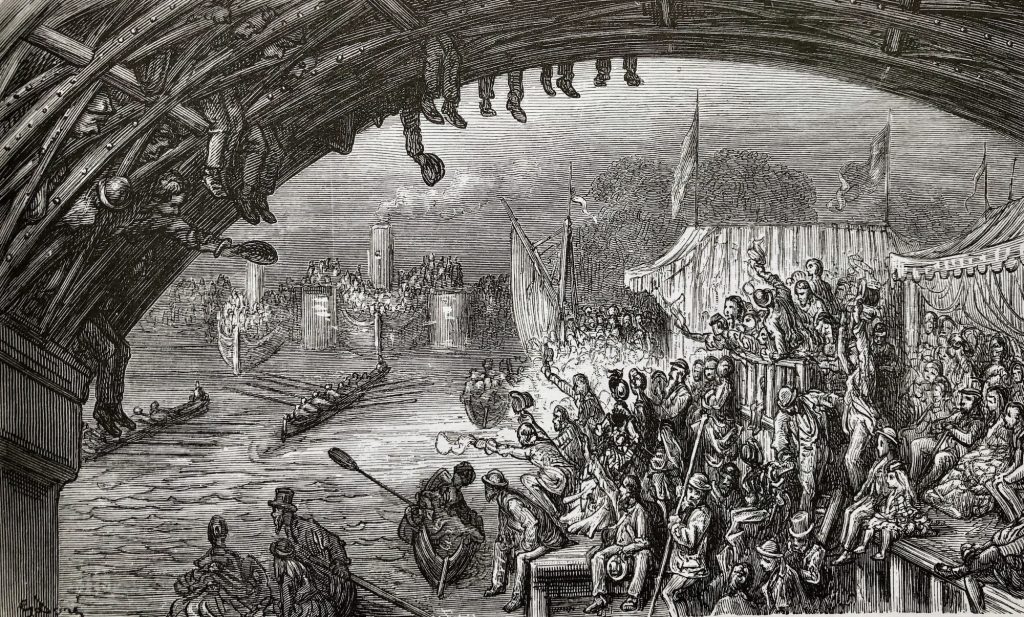
The bridge at the foot of the image is the aqueduct that carried mains water across the Thames to Chelsea. The old Putney Bridge is barely visible. When it was replaced in 1886 the aqueduct was built beneath the pavement of the new bridge.
The illustration above appeared in The Graphic three days after the race of 1870 described by Jerrold. Following the the Oxford and Cambridge boats, behind the official boats with the Umpire and other dignitaries, an Armada of rowing and sailing boats spreads out across the river. More boats of spectators are positioned along both banks the whole length of the course.
As Doré paints exuberant pictures of London at play around the Thames, so Jerrold describes Londoners enjoying the event and all the sideshows along with it: “The vibration of vigorous human life that thrilled along the shores on the April day when all London turned out to see a tussle between two University crews; was not that of a mournful, dejected population.”
Looking down from the more fortunate private riverside terraces; “the views of the towing paths presented a mixed population that, even in its holiday guise, showed marks of the fierce London struggle: The mechanics and their wives and children looked pale, but they were of buoyant spirits.”
Jerrold evokes the spirit and sheer popularity of the riverside festival. “The lines of boats and barges drawn up on either side of the river, leaving a fair open way to the race, and covered with motley thousands, sent forth tumultuous sounds of undying gaiety— through hours, pending the event of the day.”
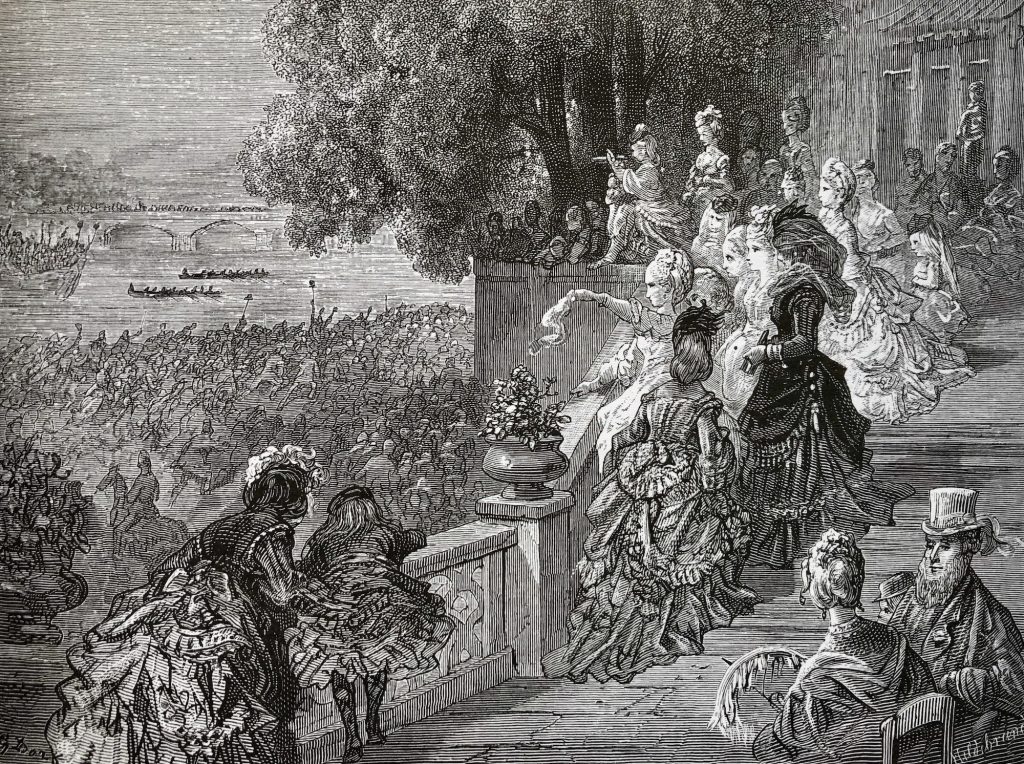
Doré’s images capture the divide between the privileged observers and the less fortunate, of whose situation, as you can see vividly in other chapters of London: a Pilgrimage, both he and Jerrold are well aware.
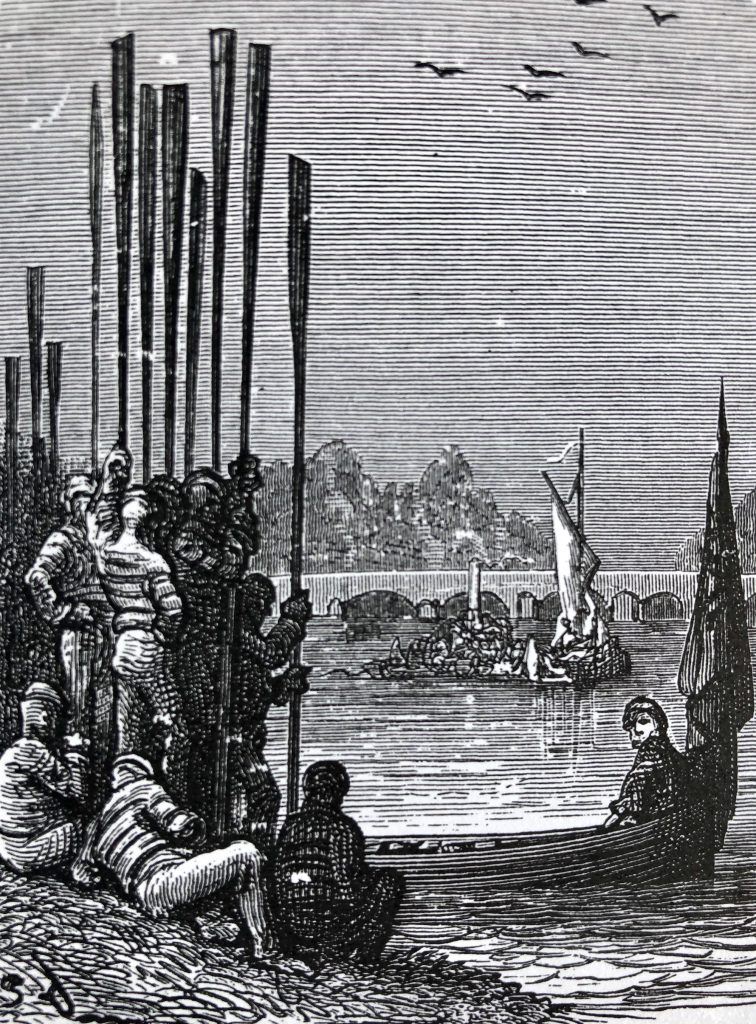
Jerrold highlights the contrast between the normal calm of Fulham, “one of the quaintest and quietest suburbs of London where people and vehicles dribble slowly over the rickety wooden bridge to Putney,” with the arrival of the undergraduates where “every kind of light and nimble, and elegant and fast, conveyance appears on the scene”. He highlights too, the contrast between the normally “quiet handsome shores fringed with noble timber, used to no more bewildering sound than the plash of an oar, or the shambling tread of the horses along the towing path” with the noise of practice and training runs and “the coarse language of the adepts in river-side slang” emanating from riverside booths and beer houses.
He observes how the undergraduates become a familiar presence in the area, and “in the wake of these young gentlemen of England, who have plenty of money and at the same time very little experience, there follow hosts of betting men of all degrees,— from the over-dressed, sharp-visaged man who lays ten pound notes, to the coarse, bibulous vagabond who scents the shillings in the waterman’s pocket.”
That said, he describes the event as “a brave and hearty and wholesome holiday […] a treat which the young men of Oxford and Cambridge offer the Londoner every spring.”
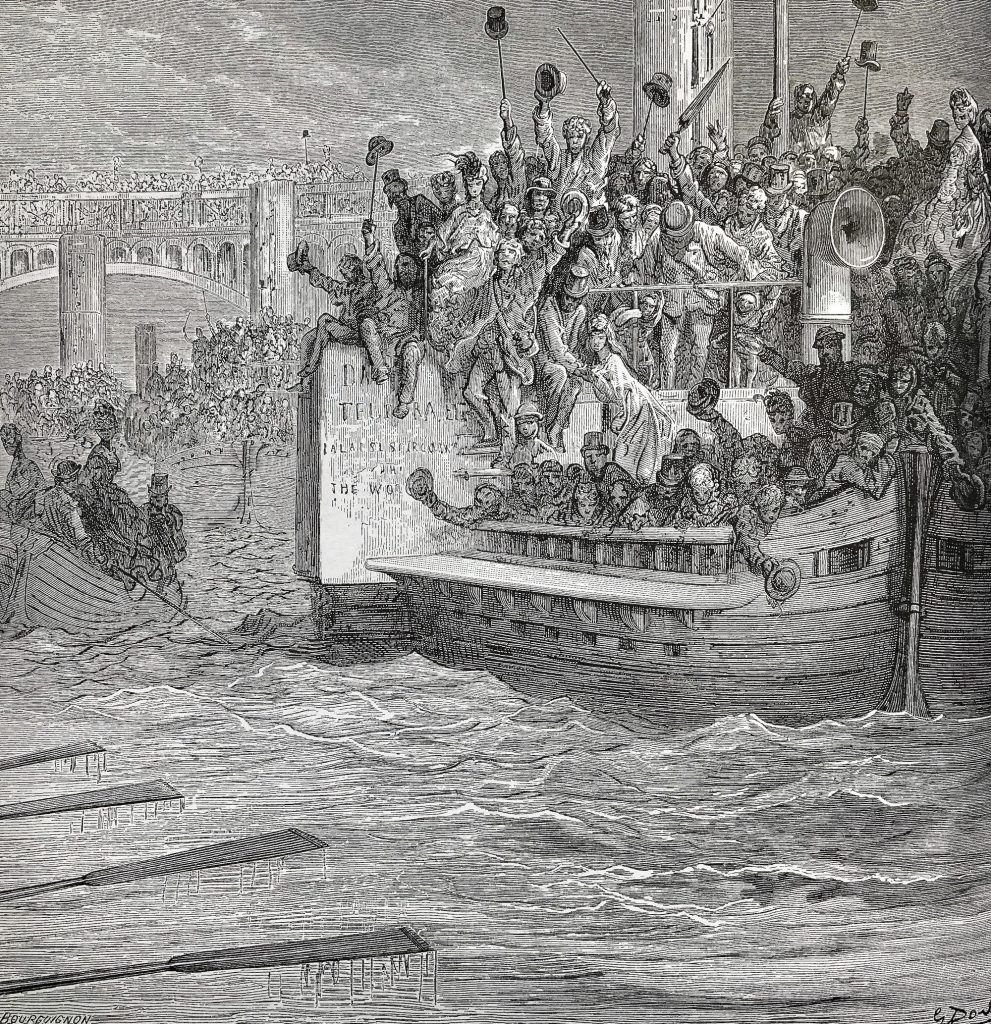
Jerrold remarks on the enthusiasm of the crowds as the sound of the starting gun rips through the air. “There is a heaving of the entire mass a low, full murmur rolls along the river banks. A spasm of intense excitement passes through the two or three hundred thousand people who have packed themselves along the shores to see the prowess of a few University lads. Desperate fellows along the towing paths, take walls by assault, force their way into boats, hoist themselves upon the shoulders of their neighbours.”
He turns his attention to the privileged company at ‘The Limes’ where “Amid frantic shouting, amid a snowstorm of pocket handkerchiefs, and delirious ravings of purple-faced betting men, two lithe, trim, swift boats, dipping one dip and feathering one flame of light – skim along the shining way.”
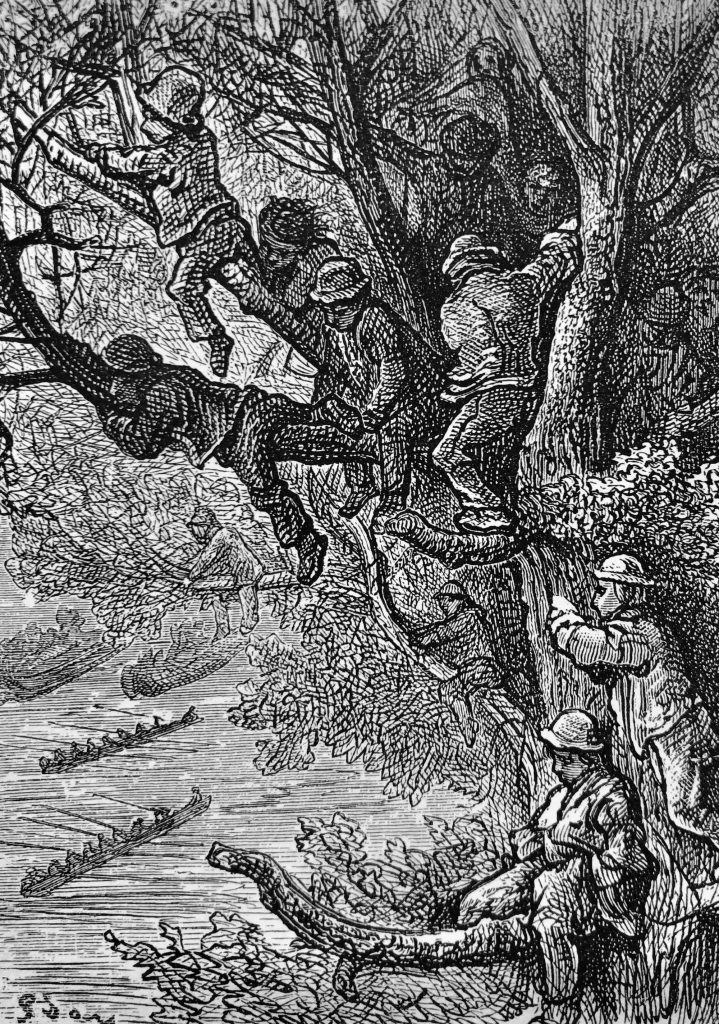
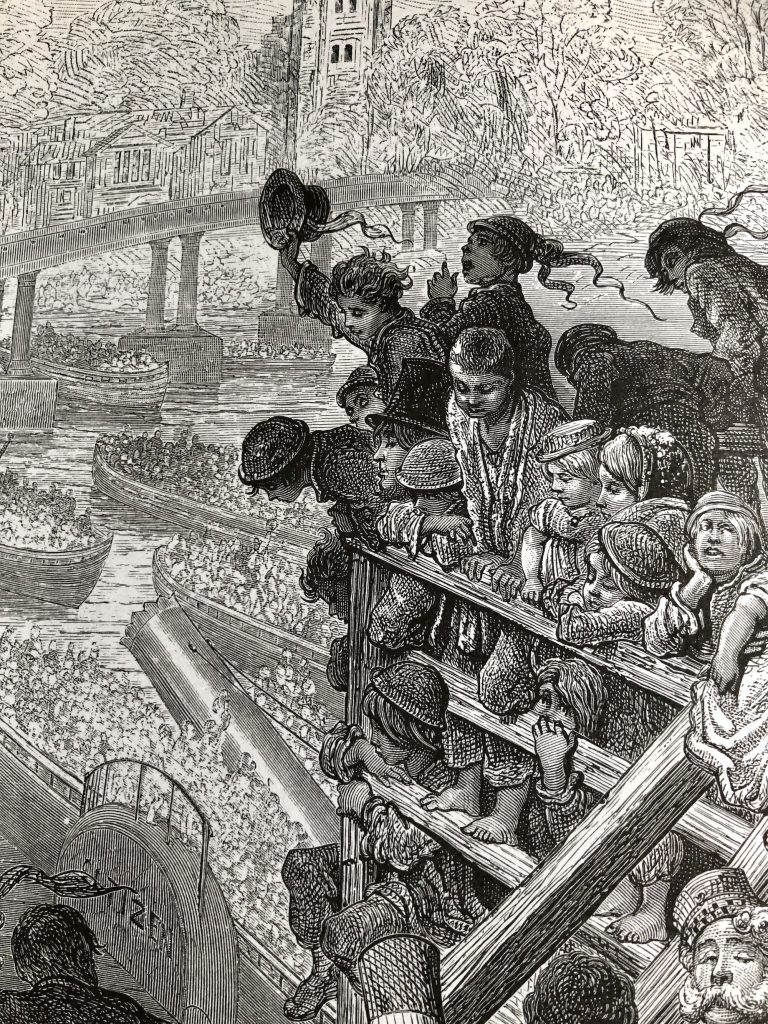
Doré was clearly impressed by the energy and spirit of the young London boys “on the parapets of the bridges, dangling from arches, swinging from the frailest boughs of trees, wading amid the rushes, paddling in the mud, scrambling, racing, fighting, shouting along the roads and river paths, or through the furze of Putney Common.” Both he and Jerrold felt mixture of emotions: amusement, pity, and admiration for these “poor, pale, lean and hungry rascals, […] tossed into the thick of the battle of life, who worked valiantly trying to earn a few pence by disentangling the carriages and leading them to their owners after the event of the day was over.”
Despite criticism of London: A Pilgrimage at the time, that it gave brutal and unflattering images of London, the book was a commercial success. And as you have seen here, the portrayals weren’t entirely negative. Doré’s engravings reflected what he saw and together with Jerrold’s observations, they made up a powerful image of London and its social disparities in the late nineteenth century.
End Notes
The 2026 Boat Races will take place on Saturday, April 4th, along the 4.25 miles of the River Thames from Putney to Mortlake.
The Women’s Boat Race will start at 14.21 and the Men’s Boat Race at 15.21.
Sources and further information
London: A pilgrimage: Doré, Gustave, and Jerrold, Blanchard, London, Grant & Co., 1872.
A London Pilgrimage by Gustave Dore and Blanchard Jerrold, from the Digital Archive of India.
Doré’s London: All 180 Illustrations from London, A Pilgrimage, New York, 2004
Know your London: The Putney Aqueduct
Royal Academy: Gustave Doré (1832 – 1883)
The London Museum: Gustave Doré’s London Pilgrimage
Peter Harrington, ‘The Journal’: Doré’s London
If you are interested to see other aspects of Doré’s finely detailed work, particularly the harsh reality of life in the East End at the time, see: ‘Gustave Doré’s East End’ by The Gentle Author.